Why Are Tv Shows Pandering to 80s Babies
What's so fascinating nearly weird children's TV shows?
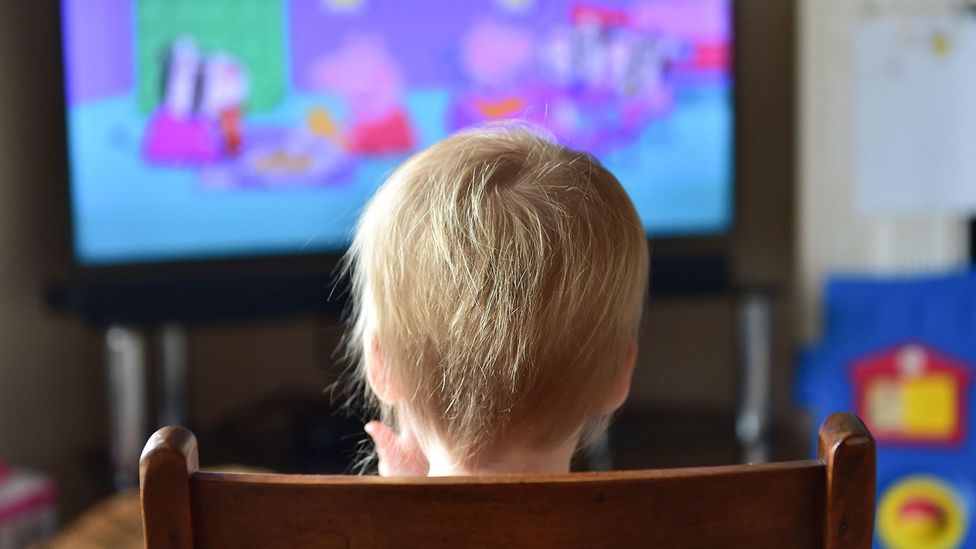
They depict hypnotic worlds filled with acidic colours and baffling plot lines, but children's television tin can requite united states surprising insights into how our brains develop as we grow up.
P
Pepi Nana stirs, and sits up in bed.
"Tiddle toddle, tiddle toddle," she says, flapping her arms, and blinking a pair of enormous round eyes. She walks over to the desk, sits down, and, using the oversized pencil in her front pocket, scribbles a letter to the Moon.
"Tiddle toddle, please come up to tea, and we tin take a story. Yours lovingly, out of the window, Pepi Nana."
She steps onto the balcony of her toy house, kisses the letter and watches it flutter up into the night heaven. What Pepi Nana doesn't know is thaton theMoon lives a waxy-looking animal with coal-black eyes called Moon Infant. He has a fixed smile and a bluish Mohican. He reads her letter, pulls upward the hood of his dressing-gown, and flies out of his crater towards Earth…
About people take a favourite Television receiver show from childhood. If yous're a parent, at that place's also probably a prove that your children adore just y'all find foreign, or fifty-fifty a bit creepy. Right now, for many parents, that evidence is Moon and Me. It follows the night-time exploits of a mismatched gear up of dolls – including Pepi Nana, a soft pink onion chosen Mr Onion, and the milky, clown-like Colly Wobble – who come to life whenever the Moon shines.
You might besides like:
• Why the fashion nosotros talk to children matters
• The secret world of babies
• How to be a practiced male parent
My 1.five-year-quondam nephew doesn't share this scepticism. As the episode nosotros're watching unfolds, he moves closer and closer to the screen, smiling, cooing, pointing and proverb "Wow". My 8-year-one-time daughter stares in slack-jawed wonder at it all.
What is it about these pre-schoolhouse Television set shows that makes them and so captivating for young viewers, but so strange to developed eyes? Equally a female parent, I've worried whether watching television at a immature age is a good for you childhood experience or a heed-rotting activeness stunting my children's development. The fact that I don't understand these shows hasn't helped.
Merely weirdness, information technology turns out, can be a good thing.
Young children's minds process information differently from adults' – what's weird for united states of america is often highly engaging for them. A improve understanding of these differences could assist create healthier, more than engaging telly programmes, boosting children's understanding of the world besides as keeping them entertained. And it could as well assistance united states parents to make better decisions almost the type of goggle box nosotros let our children watch.
Moon and Me, information technology turns out, is a product of research, informed by a collaboration between the co-creator of the hitting show Teletubbies – Andrew Davenport – and Dylan Yamada-Rice, a researcher specialising in children's instruction and storytelling, to study how children interact with toy houses.
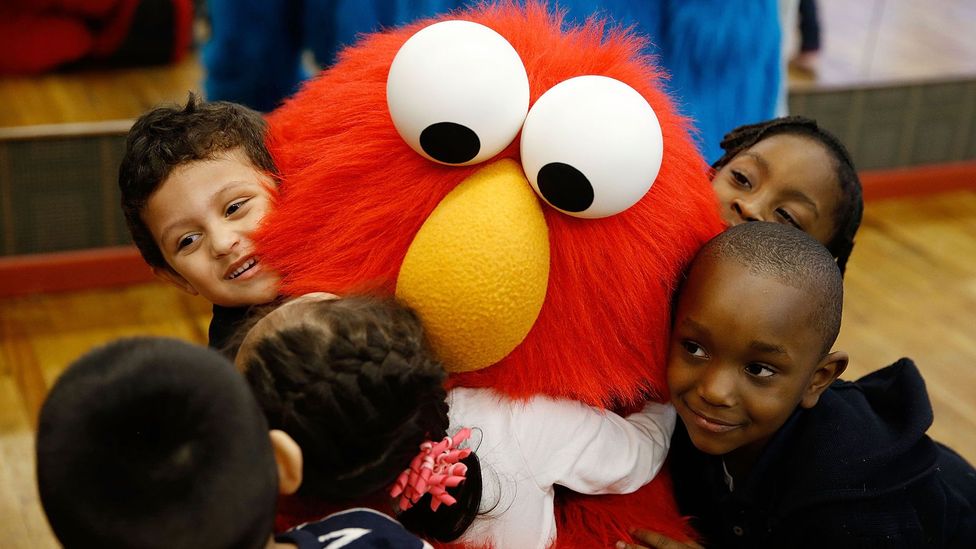
Sesame Street employed developmental psychologists and educational activity experts from the outset to assist brand every episode educational (Credit: Getty Images)
Such directly collaborations between academics and children'south TV are non new. Sesame Street, which historic its 50th ceremony in 2019, employed developmental psychologists and pedagogy experts every bit part of the production team from the commencement. Co-creator Joan Ganz Cooney thought television might be used every bit an educational tool to better prepare kids for kindergarten.
By Jan 1970, just a few months afterwards it first aired, roughly a third of two-to-v-year-olds in the Us regularly watched the testify, with upwards of five one thousand thousand children tuning in to each episode. And although it was entertaining, every episode was – and notwithstanding is – planned with specific learning objectives in mind.
"The Sesame mission is to assist children grow smarter, stronger and kinder," says Rosemarie Truglio, a developmental psychologist who is senior vice president of curriculum and content at Sesame Workshop.
Has it succeeded? By the late 1960s, most The states households owned a telly set, merely whether they could sentry Sesame Street depended on where they lived, because in some areas information technology was broadcast on Very High Frequency (VHF) channels, in others on Ultra High Frequency (UHF) channels. UHF signals were weaker, and some TV sets couldn't receive them, which meant only around two-thirds of Americans had access to Sesame Street.
"Simply the act of being exposed to the testify and watching information technology routinely increased school performance amid the children who were able to view it," says Phillip Levine, an economist at Wellesley College in Massachusetts, citing the results of a written report he and Melissa Kearney at the University of Maryland published. They found that children who watched Sesame Street were more likely to be academically on rails, and less likely to be held back, than those who didn't. Crucially, access to a VHF signal wasn't contingent on parents' wealth or educational activity – factors which might take afflicted children'southward later school functioning. In fact, the written report showed that children growing up in "economically disadvantaged" communities benefited the well-nigh from watching Sesame Street.
Simply not all television is equally concerned with children's didactics.
In the late 2000s, Angeline Lillard, a developmental psychologist at the University of Virginia in Charlottesville, was looking at how children's behaviour might be affected past the means goggle box characters behaved. Her team had been watching a lot of SpongeBob SquarePants – an American cartoon about a talking yellow sea sponge living in a pineapple at the bottom of the bounding main. The show is eclectic, to say the least, something that has helped it attain a cult following with children and adults alike.
"We were watching a whole lot ofSpongeBob in lab meetings, and I felt I just couldn't get whatever work done afterwards," Lillard recalls. "I idea: 'If that happens to me after watching it, I wonder what happens to four-year-olds.'"
This prompted her to start a new study, looking at the touch on of goggle box viewing on children's executive part – a set of cognitive abilities that include focusing attending, planning, deferring gratification and managing emotions. Compared to watching a dissimilar children's cartoon, called Caillou (well-nigh the everyday life of a iv-yr-old), or just doodling on paper with crayons, watchingSpongeBob dumb 4-year-olds' performance on various tests, including reciting a list of numbers in reverse, and learning to affect their toes when beingness instructed to bear upon their caput.
At the time, Lillard thought it might have been the fast-paced editing that was to arraign. In the SpongeBob clip they used, the scene inverse roughly every xi seconds, whereas in Caillou information technology was every 34 seconds.
Four years later, she published the results of a more thorough follow-up study. It wasn't the speed of cuts that was problematic, simply how much fantastical, physics-defying content they independent.
"Very early in life, if not innately, babies have a folk understanding of having things autumn, or that if something pushes against something else, it is going to autumn down," Lillard explains. But what happens is that a car flies through the air, then it winds up in outer space, so all of a sudden they're skiing down a slope, they're under the sea, they pour cat food out of a box and what comes out is far more could possibly take fitted inside the box… It's just ane affair after some other that tin can't possibly happen in the real world. "Our brains aren't prepare to procedure all of that," says Lillard. "My inkling is that the prefrontal cortex is working hard to figure all that out so POOF! It can't do it. Information technology's just not realistic."
Lillard stresses that they take but observed a short-term effect – in that location's no directly evidence to advise that watching highly fantastical content will harm your child in the long run – but children as old as six were affected (they haven't studied older children).
And information technology wasn't just SpongeBob. Martha Speaks – a program about a dog who gains the ability to speak English after drinking some alphabet soup, intended to teach children vocabulary – had a similar effect, as did a relatively tedious-paced cartoon called Little Einsteins, nigh 4 pre-schoolers helping a fairy put the Northern Lights dorsum in the sky. Even well-intentioned educational programmes tin can backfire if their content isn't age-advisable.
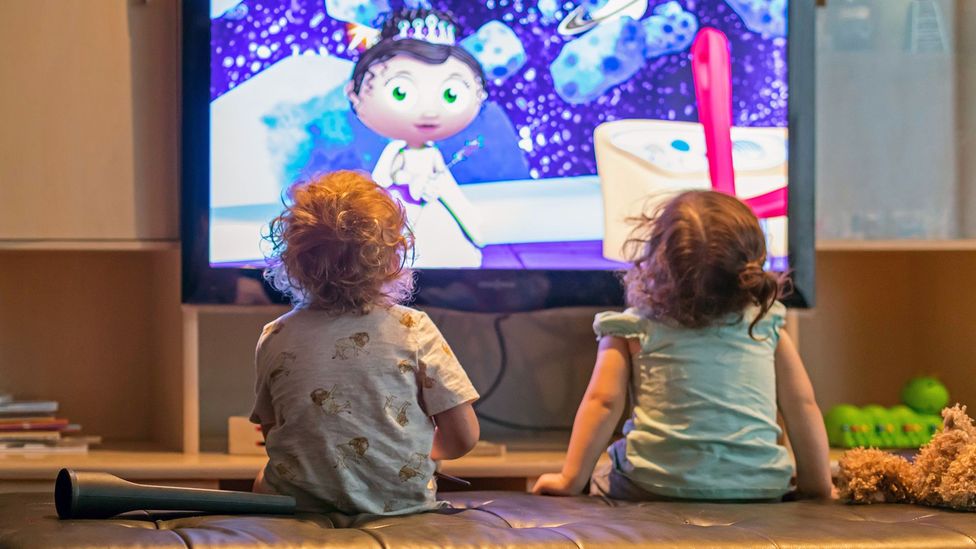
Young children'south attention is attracted towards very unlike things compared to adults so tv shows use this to assistance them follow what is going on (Credit: Alamy)
A series of photographs appear on the screen: two yellow wooden ducks against a white background; two turtles swimming underwater; ii lion cubs in the African savannah. Soothing classical music plays in the background.
This is a short clip from Baby Einstein: Numbers Plant nursery, which aims to introduce infants to the numbers one to five, and I'k watching it with Tim Smith, a developmental psychologist at Birkbeck Babylab in London.
Smith tells me his colleague showed this video to 6-calendar month and 12-month-olds, tracking their gaze to gauge their interest in the images and whether they were looking at both objects, which is obviously of import if you lot're trying to teach the concept of "two". After watching the clips, they would inquire the parents what they thought of them.
The parents would say, "I really liked the $.25 with those king of beasts cubs and the turtles, those were really cute. My picayune 1 adored those bits equally well." But the researchers noticed that the children seemed uninterested in these scenes.
Smith thinks this is considering toddlers' young visual systems struggle to pick out the creatures from their backgrounds. He shows me a second sequence developed by another colleague, who worked with a idiot box company called Abbey Home Media.
A 2D cut-out of a lamb spins down onto a plain green screen while the narrator says: "It'south a lamb." The same matter happens twice more than. Then the whole sequence repeatsagain, only this time the narrator says "One, two, three," equally each lamb lands. It's boring. It's repetitive. Just when the aforementioned babies who watched Baby Einstein were shown this, their eyes tracked the arrival of each lamb, suggesting that they were engaged and following it.
A memory floods back to me: sitting on the sofa, trying to go my own young kids to watch the BBC nature documentary Blueish Planet. At the fourth dimension, information technology seemed relaxing, educational – surely real porpoises and polar bears are far better than countless repeats of Peppa Pig? But they seemed completely uninterested. Now I know why.
Smith pulls up a dissimilar video. A 3-year-old girl in a pink patterned cardigan sits on her mum'south lap watching TV. Some other window shows what she's looking at: Waybuloo – a British-Canadian children'south Boob tube series, featuring four CGI animated characters with unnaturally large heads and eyes, floating around a fantastical land called Nara.
The daughter is hooked upward to eye-tracking equipment, and, every bit the freakishly beautiful "Piplings" float around, her optics precisely track their movements, confirming that it's these creatures, rather than the mountains or trees in the background, that have engaged her interest. Smith tells me Waybuloo is so constructive that Babylabs around the earth at present apply a clip from it, or similar children's cartoons, whenever they need to draw the attention of a child dorsum to what they want them to look at on the screen.
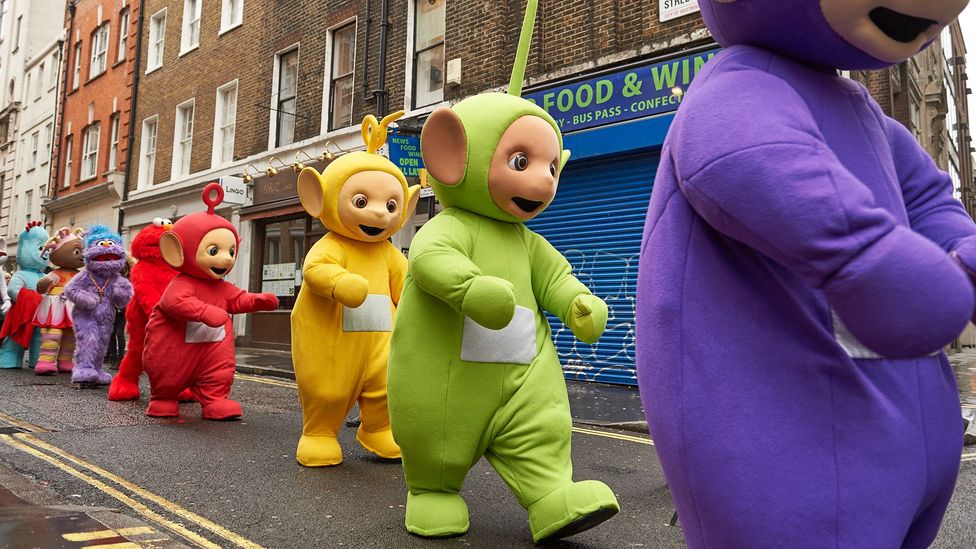
Children's Tv set characters often have large, simplified faces and apply bright colours to enable infants' sluggish attention systems to proceed up (Credit: Getty Images)
The Tv set screen flickers. Now the little girl is watching a movie of three women spaced out in a line, each holding a brightly coloured ball. Smith points out the girl'south eye movements. To start with, she looks at each of their faces in turn. Now, as the women brainstorm to dance on the spot, her attending switches between them. Next, the women take it in turns to throw their ball in the air or milkshake it from side to side, the girl's attention drawn to these bright, moving objects.
I watch earlier footage of the same daughter when she was simply a twelvemonth sometime. Her enormous chocolate-brown optics show a gaze that is more than sluggish, less coordinated, drawn less to faces and more towards any movement on the screen – and to those brightly coloured balls.
It'due south a subtle difference, but if you want to concenter a young child'southward attention towards an object or character, you have to point all the visual information in a scene towards it or they will struggle to follow the story. That's why children's Tv set shows accept big caricatured faces, often with things sticking out of their heads. "So when they movement their heads, there's a lot of peripheral motion," says Smith. "There'due south also lots of luminance and colour contrast that guides their attending to it. Yous're helping them to discover the affair they're interested in."
In 2014, he published a report showing how closely attention-grabbing features, such as color, brightness and movement, matched the location of the main speaking character in frames from children's TV shows, compared with six developed shows. "We wanted to see whether the producers of these children's shows have, through trial and error, developed techniques that effectively help infants to understand and process information," Smith was quoted equally saying at the time.
They had. Paring downwards the action enables infants' sluggish attentional and visual systems to keep upward. And characters' optics tend to be very clearly marked, the outlines of their faces often set against white, or uniform-coloured backgrounds, making them stand up out even more than.
Information technology means that even with a very primitive visual system, yous're nonetheless able to very quickly identify that main speaking character. This makes information technology easier for children to follow the story and potentially learn from it.
Andrew Davenport – the producer of Teletubbies and Moon and Me – studied oral communication therapy at academy, but his real passion was drama.
Upon graduating, he and a friend ready a theatre production visitor, and it was through this that he landed a chore equally a writer and puppeteer on a Ragdoll Productions show called Tots TV. The show, which featured three ragdoll friends, their pet donkey and a mischievous dog, won two BAFTA awards, finding audiences in the United kingdom, US, Central and South America. Simply information technology was nothing compared to what Davenport did next.
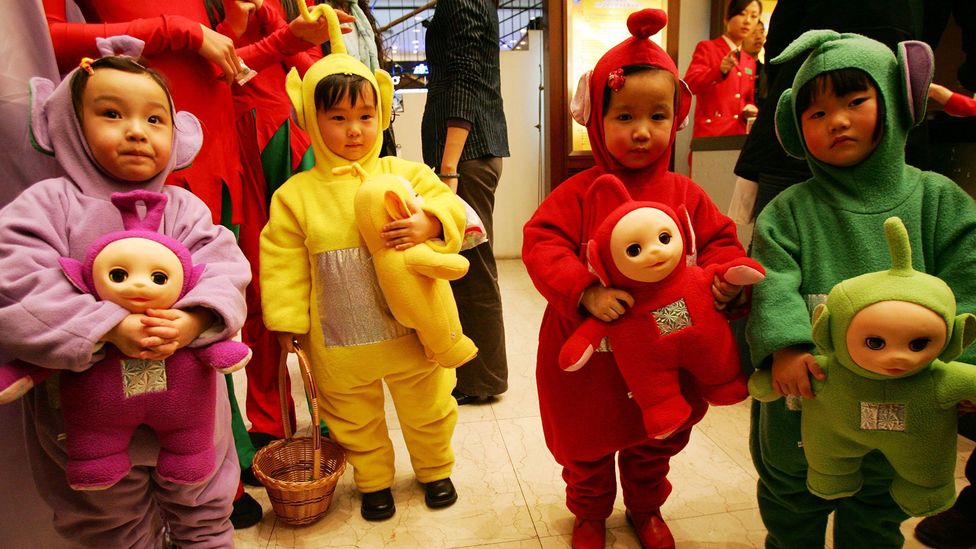
The Teletubbies obtained worldwide appeal perhaps considering it was specifically designed for 1 and two yr olds (Credit: Getty Images)
Teletubbies was the TV equivalent of a Hollywood blockbuster, going on to air in over 120 territories in 45 dissimilar languages. Tinky Winky, Dipsy, Laa-Laa and Po were inspired by a trip to the Smithsonian Institution in Washington with Anne Wood, founder and creative director at Ragdoll. They wandered into an exhibition near space and Davenport said, "Isn't it weird how they put all this engineering science into the spacesuits, and when you see them walking about in them, they look as much like babies in nappies as anything."
The Teletubbies were conceived every bit technological babies, set up in a technological superdome. Even the windmill on the hill is a nod to one of the offset pieces of technology children encounter: a pinwheel on their pram. Their bodies were painted vivid fluorescent colours, considering that seemed to fit with the technology theme, as did putting the Idiot box screens on their stomachs – TVs that showed videos of children doing uncomplicated activities out in the existent globe.
"For me, Teletubbies is entirely effectually that early stage of life when the child is coming to grips with their own body and their ain physicality: walking, talking, running, falling over – all of the things that the Teletubbies did," says Davenport. The green-hilled gear up was designed to accentuate the depth of the physical space they inhabited, and much of the bear witness simply involved the Teletubbies coming and going and popping up and down, playing with those physical concepts.
Some adults, however, didn't become it. The bear witness was accused of "dumbing down" children's Tv set and criticised for its constant repetition, poor plots and lack of sense of identify. But that was exactly the point. Teletubbies was perhaps the first TV prove specifically designed for one-to-ii-yr-olds. One Norwegian Television receiver executive has described it equally "the most marketplace-oriented children's plan I've ever seen".
Davenport and Wood had learned the visual equivalent of baby talk. If the Teletubbies are weird, it'south because – visually and developmentally – so are infants.
For Forest, the pattern of shows like Teletubbies is intuition combined with years of trial and fault. "I call up the only skill I have, if I take one, is being able to picket a screen like a three-year-sometime might. It is well-nigh knowing when to pause, how long to interruption for, how to make that comic, how to employ apprehension."
Although children live in the aforementioned world as us, they perceive information technology differently. A little daughter with a baby blood brother might posit that all babies are built-in boys, and so plow into girls, for instance. Or that houses autumn down to Earth then walk into position, using their legs. "You tin see how young children will often say things that we remember are funny considering their perception is that X is the instance, when in fact Y is the case. That departure needs to exist respected, but equally information technology can be the stuff of content," says Wood.
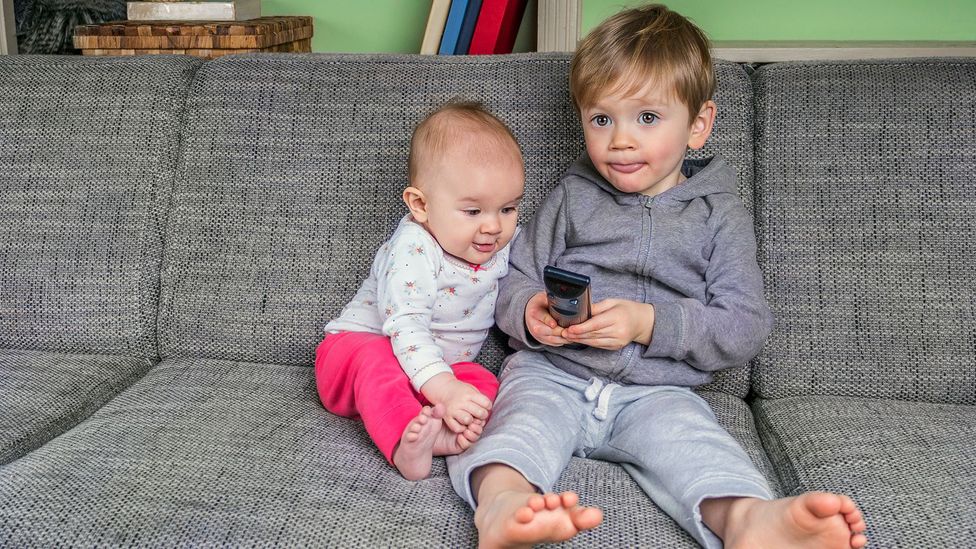
Engaging with what children are watching on television may be a good way for parents to aid their youngsters larn more (Credit: Alamy)
Often, her programmes are designed as a conversation between the television and the children watching it. "When people objected to Teletubbies, nosotros used to say: 'Look, Teletubbies empathize babies, and babies understand Teletubbies. If you're watching Teletubbies without a child, you lot are only getting i half of the conversation.'"
She cites the offset of the bear witness, where a boat goes out of frame, then comes back in, so goes out of frame again. "That sequence is virtually playing a peekaboo game with a very young child: Where's the boat gone? Here it is, coming back again." A recent survey found that a game of peekaboo is the surest way to brand a baby express mirth.
After the success of Teletubbies, Davenport and Wood moved on to In the Night Garden, which Davenport describes as a "gimmicky nursery rhyme" aimed at two-to-iii-year-olds. "Information technology'southward that stage where the kid has come to grips with the physicality of the world and is now fascinated with the idea of turning what it knows on its head in an abstract way – the time when nursery rhymes, language play, symbolic play, toy play kickoff to become the affair." Each character is designed to stand up alone, just like Humpty Dumpty or The Sometime Woman Who Lived in a Shoe practice in a book of nursery rhymes.
The cardinal grapheme, Iggle Piggle, represents a kind of "every-child", who lollops effectually trying to make sense of information technology all. Davenport says he was inspired by a little girl who used to say "Iggle Piggle Iggle Piggle Iggle Piggle" whenever she was excited. There'south too Makka Pakka, a biscuit, round-bodied creature, with a penchant for collecting piles of rocks and washing things with a sponge.
Davenport is fascinated past the thought of accessing his audience through their own preoccupations and interests. Rock-collecting was a childhood hobby of his, while the obsessive washing is not about cleanliness but engaging with an activity that many young children find challenging: washing their faces and getting ready for bed. "The idea is that you tin can create these piffling nuggets of activeness, routine, rhyme or song which get something that parents and children tin can share together to get through something that might be tricky or difficult," he explains.
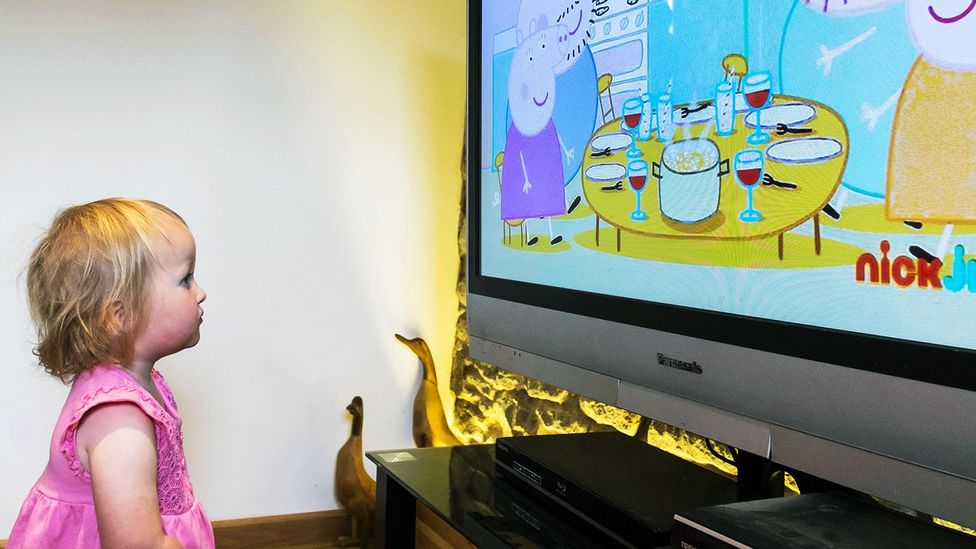
Many parents worry about the goggle box their children are watching but some studies show that the right kind of programming can have positive effects (Credit: Alamy)
I remember In the Night Garden's opening sequence – which involves a rhyme about a lilliputian gunkhole no bigger than your hand circling circular and around in the ocean, while an developed traces circles on a child'southward palm. It was a failsafe manner to put my son to sleep. When I tell him, Davenport sounds genuinely moved. "When these things are working, they exercise go components of the human relationship between the parent and the kid".
Davenport has seen his godson using Makka Pakka'south song equally a way to wash his hair and face. "When y'all find that something is useful, that'due south obviously incredibly satisfying and rewarding," he says.
This is what led him to approach the University of Sheffield during the development of Moon and Me. He'd read a report where two groups of children were taught a lesson including either standard materials or some involving the Teletubbies. Those working with the Teletubbies material seemed far more engaged than in their normal lessons – in one case a kid who barely spoke and inappreciably took role in class activities returned their completed chore asking for another i.
"If you approach children through their ain culture, rather than imposing your civilization on them, they are much more motivated and more interested," says Davenport.
Having read about the piece of work with Teletubbies, and becoming intrigued by the idea of child civilisation, he approached the researchers well-nigh doing a report to learn more about how gimmicky children play with toy houses. The result was his collaboration with Dylan Yamada-Rice, now at the Royal College of Art in London.
Moon and Me is aimed at a broader historic period range than either Teletubbies or Night Garden. Information technology'due south a tale about a toy house coming to life at night, of the sort that were pop in the 1940s and 50s.
"At that place is still a general assumption that stuff tin can exist fabricated for adults and just dumbed downwards for kids without looking specifically at the needs of that young audition," she says. Just if you want them to learn annihilation from it, you need to find ways of engaging that young audience.
"If you lot tin't believe in the depth of the character and that one character securely cares about another character, and so you're not going to be very constructive in maintaining children'southward interest. And if yous don't believe in that character, and so you're not going to care that they are writing a letter to the moon."
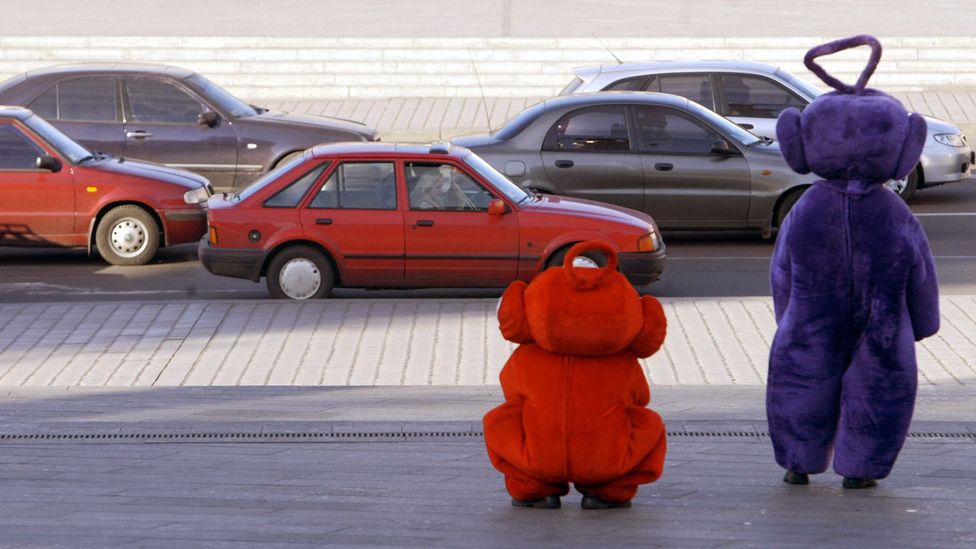
Children who were taught lessons using materials involving the Teletubbies were far more engaged than those without co-ordinate to 1 study (Credit: Getty Images)
Yamada-Rice joined together two large toy houses from the department store John Lewis, and fitted them with tiny cameras, pointed non at the children but at the toys within the houses. They so assembled a grouping of one-to-v-year-olds from different cultural backgrounds and prepare them loose on the toys, recording how the toys were moved, what the children were maxim as they played with the characters and what voices they were giving them.
One thing they noticed was the children's preoccupation with transitions: going up and down the stairs; in and out through the front end door; into bed for sleep and back out again; and the importance of sitting down for tea. Another ascertainment was how the children oft had multiple scenarios occurring on different floors of the houses. "Maintaining them all was a bit like spinning plates," says Davenport. "So, a shot which recurs a lot in Moon and Me is of the whole house with all 3 floors exposed, so you can run across the characters on the unlike floors and stairs".
I sit down with Tim Smith and watch an episode. There's the narrator tucking the diverse characters into bed on the different floors of the firm. There's Moon Infant ringing the front doorbell and Pepi Nana letting him in. There'due south a shot of Pepi Nana walking downward every step of a staircase.
Smith points out the moonlight lighting upwards Pepi Nana'southward face as she sits up in bed; the use of noises, such every bit Colly Wobble'due south tinkling bell, to cue viewers' attention and prompt them to seek him out; the adult narrator asking "What's next?" as Mr Onions lays the table, then a subtle wink of movement virtually the cups. All of these, he says, assistance engage the child's attention and help them to follow the story.
Immature children can become transfixed by television programmes that adults discover utterly inexplainable (Credit: Alamy)
There are subtle lessons woven into the cloth of Moon and Me, such as the art of structuring a alphabetic character, and telling a story – core principles of early-years education – or Pepi Nana climbing into a tub, which rolls abroad, and and then popping out of it again, which helps teach about object permanence. Davenport tells me his shows aren't intended to exist "educational". His audition, he says, is pre-educational. He strives to provide what he describes as "the "unfatiguable" exercise of mind".
Here's the general dominion: earlier the age of two, kids won't get much out of Television set – unless an adult is sitting with them, helping them to understand it.
"The way we tend to make television for kids is to create stories through a narrative that unfolds over time with characters interacting," says Heather Kirkorian, a developmental psychologist at the University of Wisconsin in Madison. "That kind of traditional narrative format probably won't work very well for kids under 2." If they lookout besides much TV, this could even undermine their development by discouraging them from interacting with the real earth.
From age two or three until they are v, children tin follow simple plots, but not complex moral lessons, such as a bully getting his or her come up-uppance at the end. "Kids at that age are not really able to be similar, 'Oh, here's this bully, and he'southward so mean, and I don't want to be like him because I'm learning that that's bad,'" says Polly Conway, senior Tv set editor at Common Sense Media, an American arrangement which tries to help parents navigate this complex maze. Rather, these young children may try to emulate the bad behaviour. "What they need to see is someone like Daniel Tiger [a pop American-Canadian cartoon character] only going through this day and learning to tie his shoes, perchance saying hello to his grandad."
School-age children tin cope with more circuitous plots and moral lessons. "Certainly, the eight-to-12 age group are able to come across that negative behaviour and understand that the message is 'Don't do this negative behaviour'," says Kirkorian. Notwithstanding, they may even so struggle with jumps in time, such equally flashbacks. In fact, it'southward non until around age 12 that children begin to have adult-like comprehension of what they meet on the screen. Her research suggests that toddlers may gain more than from simple interactive apps, like games or even video chats, than from TV shows.
"All television content is teaching something. The question is what is it educational activity?" Joan Ganz Cooney, the co-creator of Sesame Street, used to say. A lot of content still portrays unhelpful stereotypes about, say, what girls and boys can practise, or features violence. "Information technology's very different from an adult brain where you tin can say, all right, this is just comedy and this is fun," says Rosemarie Truglio of the Sesame Foundation.
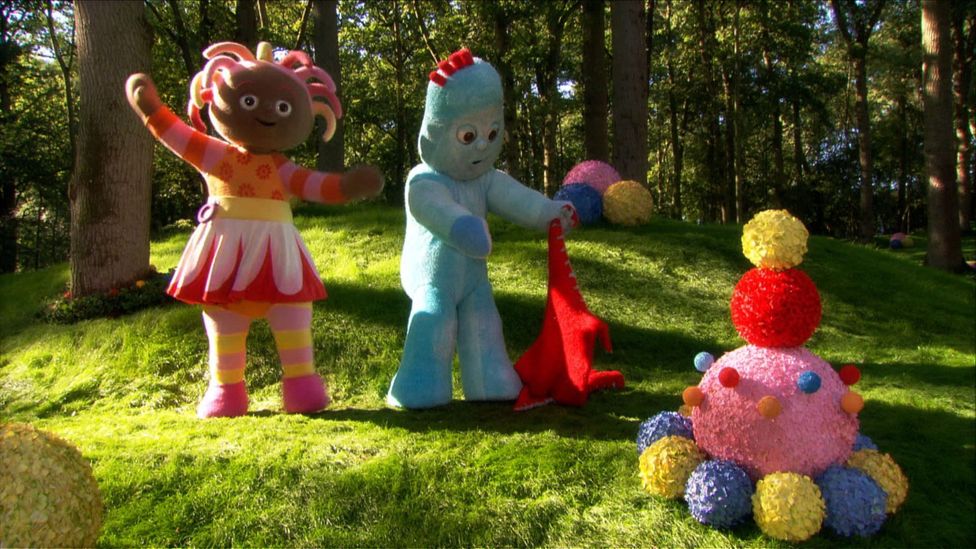
The characters from In the Night Garden are intended to have the same preoccupations and interests equally the young audience who watch them (Credit: BBC)
Truglio says the best way for kids to watch the programme – any program – is with a caregiver. That way you can reinforce the educational messages they are getting from the TV set up. Co-watching with older kids tin can also exist tin be useful, considering if yous spot them enjoying something with dubious morals or stereotypes, then you tin can open a discussion about it.
A lot of studies have shown that standard adult-focused form will lead to very poor transference of knowledge to the real world, Tim Smith tells me. Merely you can overcome that, either by having the show engage with the young children, for instance by asking them questions, or, more than importantly, by having another person there. Children tin exist highly engaged and cognitively active, simply their attending is always limited, says Smith. He suggests occasionally pressing interruption, giving children the time to engage and discussing what they're watching.
As a mother of two, all of this sounds good in principle. But sometimes we only want some peace and quiet. Sometimes we've got stuff to do. Sometimes we've been playing with them for three hours and need a suspension.
When I was immature, kids' Television was simply available for a few hours a solar day. And so forth came Nickelodeon and the Disney Channel. Now it'south YouTube and Netflix on demand.
I'm reassured that occasionally employing Iggle Piggle or Moon Baby is unlikely to be harmful. But I'thou also inspired – to not necessarily switch off when the TV or iPad is switched on. Considering with a lilliputian more than try from me, it tin can be something even amend: a weird earth that we can explore together.
* This is an edited version of an article that was first published byWellcome on Mosaic and is republished hither nether a Artistic Commons licence.
--
Bring together ane million Future fans by liking us on Facebook , or follow u.s.a. on Twitter or Instagram .
If you liked this story, sign up for the weekly bbc.com features newsletter , chosen "The Essential List". A handpicked option of stories from BBC Time to come, Civilisation, Worklife, and Travel, delivered to your inbox every Friday.
Source: https://www.bbc.com/future/article/20191206-why-children-find-weird-television-so-mesmerising

Post a Comment for "Why Are Tv Shows Pandering to 80s Babies"